
By Eiliana Wright
Like teachers across America, Lauren Worman remains in her classroom after the bell rings to wrap up lessons and prepare new ones for the young minds she is responsible for.
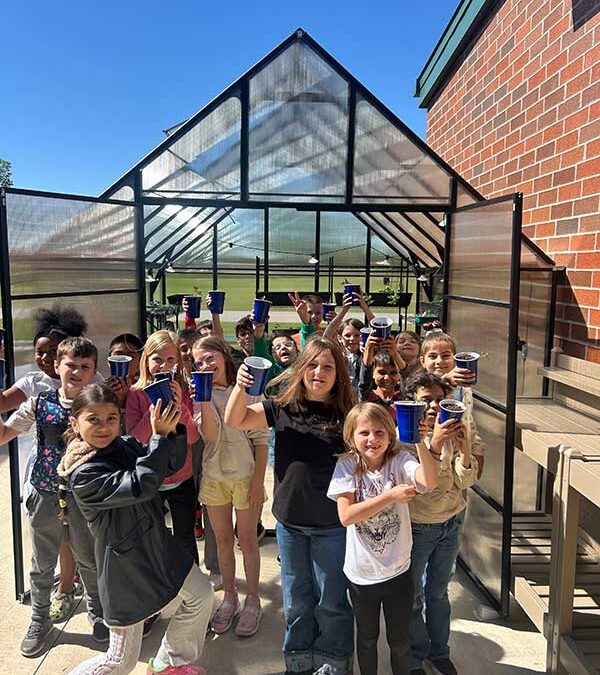
At whatever point she’s ready, Worman puts down her work, meets her Garden Club at the school’s side door, and like a mama duck with her ducklings, leads the group toward the greenhouse right outside to tend the garden that’s been helping her teach.
Schools in the State of Ohio choose their own curriculum, which provides content and a timeline for teachers to follow through the school year. Lessons are taught with personalized teaching style, but benchmarks must be met.
Worman has taught kindergarten for eight years and second grade for seven. She has seen the emphasis shift from hands-on learning to curriculum comprehension.
“It is hard when you want to do all of these fun activities and really engross the kids in them but you don’t have the additional time,” Worman said. Worman added that while she sees gains, the new structure takes away learning immersion.
The new greenhouse was her plan to get some of that back. This past school year Bethel Elementary School used the Wit and Wisdom curriculum created by Great Minds. The year started with stories about change connected to science, nutrition, history and reading comprehension. Then Worman bent the curriculum towards hands-on activities she misses from the old days.
Her idea was a greenhouse that incorporated lessons into a garden setting, then further supported those lessons by connecting with Miami Valley Career Technology Center students. CTC students brought lessons they’d learned from farming, culinary arts, and physical health classes and connected them to the second grader’s curriculum.
On one occasion, Worman remembered, the CTC culinary class helped students prepare vegetables for stone soup, as they had just recently read the famous folktale in class.
If the garden yields a crop in the future, Worman dreams of donations to Bethel Hope, a local nonprofit that provides food and financial resources to residents of Bethel Township.
The idea for a greenhouse was exciting, but Worman had to find funds, and she found them in the Radle Fund for Science Education, awarded by Tipp City Foundation. The fund was created in memory of Woodrow and Mary Radle, who were from Bethel Township and were supporters of science education.
Jim Ranft, the Chairman of the Distribution Committee with the Tipp City Foundation, remembers that Worman’s grant proposal for the greenhouse was unique because of how many boxes it checked.
The foundation liked that the greenhouse was “new and different,” not yet supported by the school budget, active outside of the curriculum, a source of connection between students young and old and an opportunity to give back to the community.
The other unique thing about Worman’s grant, Ranft said, was that her project received more than the amount of money originally requested. The request was only for $2,500, but Worman received $3,610 for her greenhouse.
Ranft explained that this is not normal, and that her proposal came at just the right time, when a large amount of the fund was still available and needed to be used because the foundation was at the end of its yearly cycle. He added that the foundation was more than happy to help support such a well-rounded project.
“It was just a great proposal across the board,” Ranft said.
The greenhouse was ordered in the fall and was constructed by the maintenance department on a patch of concrete south of the new elementary building by April of 2026. Students watched construction through the windows of the elementary hallway and did routine checks on the row of starter seeds they planted in red solo cups that remained on the classroom windowsill, destined for their new home.
The seeds sprouted, and when the time was right, Worman took students to plant them in the greenhouse, with a lesson plan ready to go. “You would think that we were in Walt Disney World,” Worman remembered. “These kids were so excited,”
Sweet corn, beans, tomatoes, and herbs were tended daily by her students and grew in the greenhouse until June, then were either taken home by students, staff, or Worman over the summer.
Worman reported that the greenhouse has been a success in and out of the classroom. The students learned lessons about plant identification, what plants need to grow, and how to care for them. “They’re like, oh that’s what we talked about all the time in those books!” Worman recalled.
The greenhouse also acts as a common denominator. “It’s really great that this is something that encompasses all of the students,” Worman said, and added that all academic levels can participate.
Bethel Elementary Secretary Julie Gravitt said from a parent perspective, she has seen the greenhouse become a success. Gravitt’s eight-year-old daughter, Makenzie, was a second-grade student at Bethel Elementary last year, so she planted sweet corn, and got to be a part of the watering club.
When asked about the greenhouse, Makenzie said “It was exciting,” especially when her and her friends found a tree frog in the greenhouse after school.
Mackenzie’s mother feels the same way. “I was really excited they were going to do something hands-on, and I just got lucky that my kid happened to be in that grade and got to experience it,” Julie said.
Next fall, Worman will start the garden with winter hardy vegetables like kale and broccoli, and plans to perpetually continue the greenhouse garden program, with hopes to yield a crop big enough to donate, and to expand the program beyond the second-grade class.